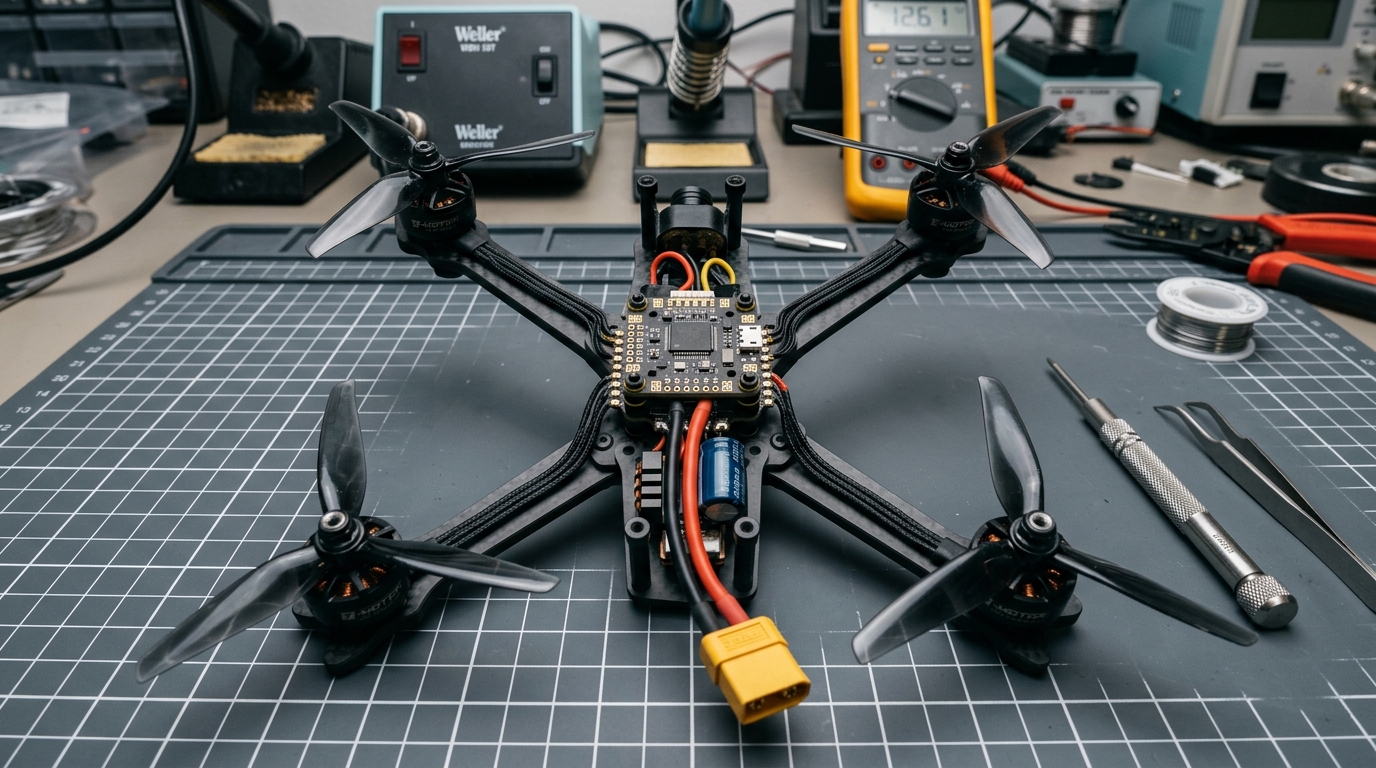
A multirotor drone consists of six interconnected hardware subsystems:
- Airframe: The carbon fiber structural skeleton providing rigidity and component mounting.
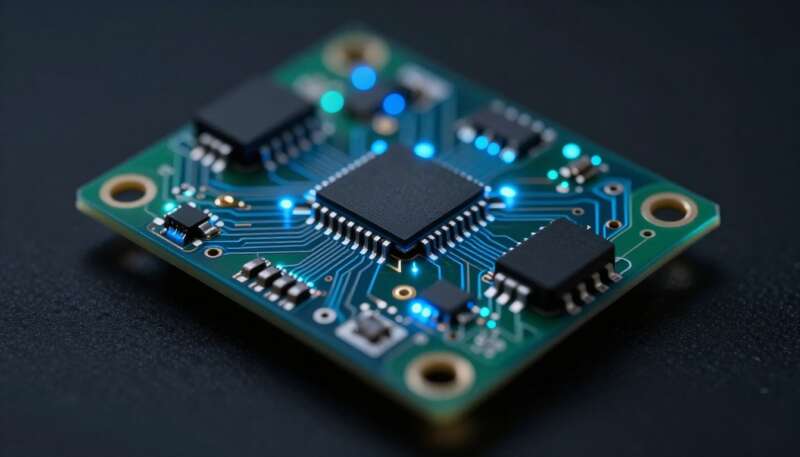
- Flight Controller (FC): The central microcontroller running sensor fusion (IMU) and stabilization loops.
- Electronic Speed Controllers (ESCs): Power inverters converting DC battery voltage into timed 3-phase AC to drive motors.
- Brushless Motors & Propellers: The electro-mechanical propulsion system generating vertical thrust and directional torque.
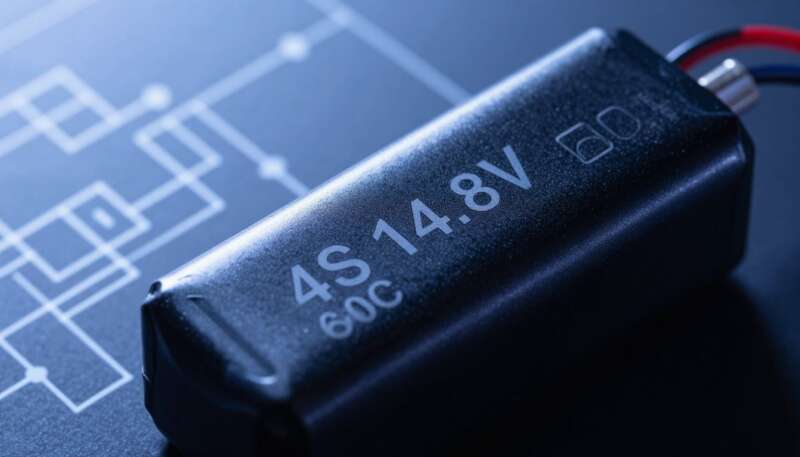
- Lithium-Polymer (LiPo) Battery: The high-discharge chemical energy reservoir powering the aircraft.
- Radio Receiver (Rx): The digital communications link receiving pilot commands and transmitting telemetry.
1. Subsystem Architecture Matrix
Every multirotor aircraft balances these six hardware elements to achieve controlled, stabilized flight. Understanding the role and key metrics of each subsystem is essential before starting any build or repair:
| Subsystem | Biological Analogy | Primary Hardware Function | Key Metrics & Ratings |
|---|---|---|---|
| Airframe | Skeleton | Structural rigidity, vibration absorption, component layout | Wheelbase (mm), Arm Thickness (mm), 3K Carbon |
| Flight Controller | Brain & Inner Ear | Sensor reading (gyro/accel), PID calculation, actuator commands | STM32 MCU (F4/F7/H7), IMU Sample Rate (kHz), UARTs |
| ESCs | Nervous System | Inverts DC to 3-phase AC; modulates motor phase timing | Continuous Current (A), Burst (A), DShot Protocol |
| Brushless Motors | Muscles | Converts electrical current into rotational torque | Stator Size (e.g., 2207), KV (RPM/Volt), Max Thrust (g) |
| Propellers | Wings | Converts rotational kinetic energy into aerodynamic lift | Diameter (in), Pitch (in), Blade Count (2/3/4) |
| LiPo Battery | Heart & Energy Pool | High-rate chemical energy storage with low internal resistance | Cell Count (S), Voltage (V), Capacity (mAh), C-Rating |
| Radio Receiver | Senses & Reflexes | Decodes pilot stick packets; transmits live telemetry back | 2.4GHz / 915MHz, ExpressLRS (CRSF), Sensitivity (dBm) |
2. Detailed Subsystem Breakdown
1. The Airframe (The Structural Skeleton)
The airframe holds all electronic and mechanical components in exact geometric alignment. Unlike hobby toys made of ABS plastic, professional and FPV multirotors are manufactured from 3K matte twill carbon fiber. Carbon fiber delivers an unmatched strength-to-weight ratio and absorbs high-frequency vibrations that could otherwise distort gyroscope readings.
Key elements include arms (typically 4mm to 6mm thick to survive hard landings), top and bottom plates forming the central avionics bay, and lightweight aluminum standoffs. Explore our curated carbon fiber drone frames designed for durability and clean airflow.
2. The Flight Controller (The Brain)
Because multirotors are inherently unstable, they require active computerized balancing. The Flight Controller (FC) reads internal orientation data from an Inertial Measurement Unit (IMU)—a miniature silicon chip containing a 3-axis gyroscope and a 3-axis accelerometer.
Operating at calculation loops up to 8,000 times per second (8kHz), the onboard STM32 microcontroller compares where the aircraft currently is with where the pilot wants it to be, computes microsecond corrections via a PID loop, and signals the motors accordingly.
3. Electronic Speed Controllers (The Power Regulators)
Brushless motors cannot run on simple direct current (DC). They require three-phase alternating electrical pulses to cycle magnetic fields inside the stator. The Electronic Speed Controller (ESC) uses high-speed MOSFET transistors to rapidly switch battery power to each motor coil.
Most modern builds utilize a compact 4-in-1 ESC board mounted directly under the flight controller, communicating via high-speed digital protocols like DShot600 or DShot300. Check out our high-efficiency 4-in-1 drone ESC stacks engineered for reliable current handling.
4. Brushless Motors & Propellers (The Propulsion Engine)
Drones rely on brushless DC (BLDC) outrunner motors. Unlike brushed motors with mechanical contacts that wear out and generate excessive heat, brushless motors feature permanent neodymium magnets spinning around stationary copper wire coils, delivering 85–90% electrical efficiency.
A motor's KV rating indicates how many RPMs it will spin for every 1 Volt of power applied with no load. Low KV motors (e.g., 1750KV) produce immense torque for large propellers on 6S voltage, while high KV motors (e.g., 2450KV) spin lighter propellers at higher speeds on 4S packs.
5. The LiPo Battery (The High-Discharge Power Plant)
During punch-outs and climbs, a performance drone can pull over 100 Amps in a split second. Drones use Lithium Polymer (LiPo) batteries because of their low internal resistance and extreme continuous discharge capability.
Packs are classified by their series cell count (e.g., 4S = 14.8V nominal, 6S = 22.2V nominal) and their C-rating, which denotes safe continuous discharge capacity. Always charge LiPo batteries with a balanced charger and store them at a safe 3.85V per cell. View our verified drone batteries and power distribution hardware.
6. The Radio Receiver & Failsafe (The Control Link)
Mounted onboard, the radio receiver catches control packets transmitted by the pilot's ground radio and relays those stick commands (throttle, roll, pitch, yaw) over a serial UART bus (CRSF) to the flight controller.
Today, open-source ExpressLRS (ELRS) operating on 2.4GHz or 868/915MHz provides industry-leading responsiveness and multi-kilometer reliability. If connection is ever severed, an automatic Failsafe disarms the motors or initiates GPS Return-to-Home (RTH).
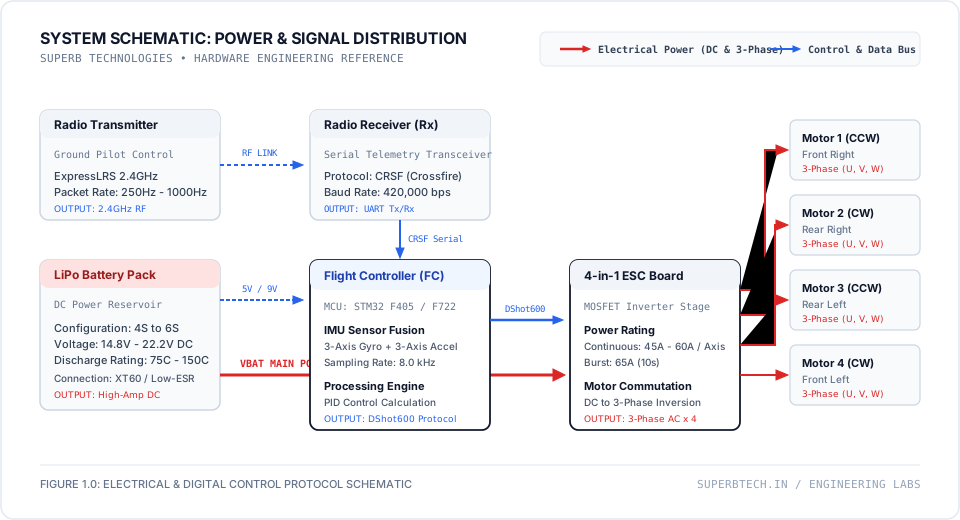
3. Power & Signal Flow Architecture
Understanding how high-amperage direct current and microsecond digital signals route simultaneously through the aircraft is crucial for diagnosing electrical noise and preventing brownouts:
4. Frequently Asked Questions (FAQ)
Can a quadcopter fly if one motor fails in mid-air?
No. A quadcopter relies on symmetrical opposing motor thrust to balance its roll, pitch, and yaw axes. If a motor cuts out, the aircraft will instantly enter a spiral tumble. Hexacopters (6 motors) and octocopters (8 motors) are used in industrial survey and cinematography specifically for single-motor failure tolerance.
What is the difference between a flight controller and an ESC?
The flight controller is a low-voltage logic computer that decides what each motor needs to do based on pilot commands and sensor data. The ESC is a high-power switching board that actually delivers the high-amperage electrical current to execute those speed commands.
Why do drones use brushless motors instead of brushed motors?
Brushed motors rely on physical carbon brushes sliding against a spinning commutator, creating electrical friction, intense heat, and mechanical wear. Brushless motors use electronic switching with no mechanical points of contact, resulting in 85–90% electrical efficiency, higher RPM capability, and zero maintenance.
What causes most first-time drone build failures?
The two most frequent hardware failure points are reverse polarity wiring (connecting battery positive to negative on the ESC, which instantly destroys the MOSFETs) and excessive mechanical vibration (loose motor screws or bent propellers transmitting acoustic noise into the flight controller's gyro).
Ready to explore the avionics brain in depth? Proceed to Part 2: Flight Controllers 101 — How Gyros, IMUs & PID Loops Stabilize Flight .